 Cart is empty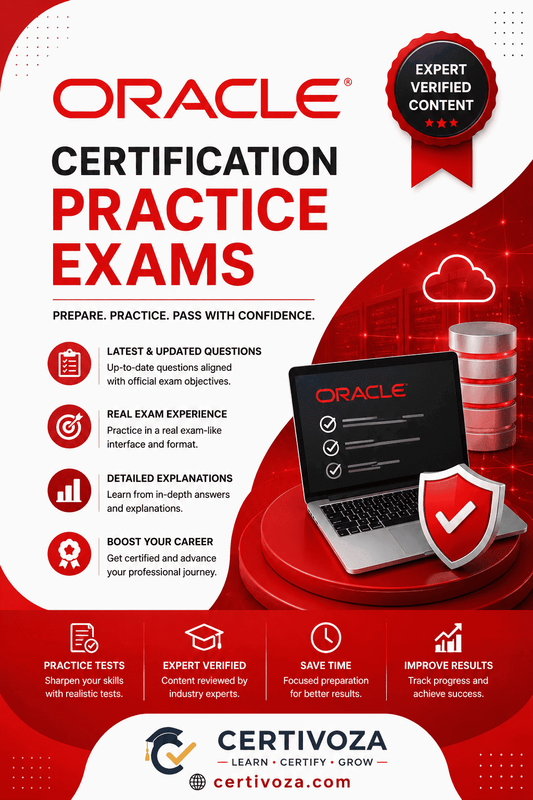
Description
1Z0-171 Oracle AI Database 26ai SQL Associate Practice Exam
Certification Overview
1Z0-171: Oracle AI Database 26ai SQL Associate focuses on the SQL skills required to retrieve, manipulate, and manage information in Oracle AI Database 26ai.
Oracle’s certification information describes the exam as validating SQL skills including different types of SELECT queries, DML operations for manipulating data, and DDL operations for managing tables. Oracle also positions these skills as important for both database developers and administrators.
Oracle’s current 26ai documentation provides a dedicated SQL Language Reference containing the complete description of Oracle SQL, together with a SQL Language Quick Reference for commonly used SQL syntax.
The 1Z0-171 practice exam is designed to help learners strengthen SQL fundamentals, improve query-writing skills, understand database objects, and prepare for scenario-based SQL questions.
What Is Covered in 1Z0-171?
The practice exam covers important Oracle SQL areas, including:
- Relational database concepts
- SQL statement fundamentals
SELECTstatements- Selecting columns
- Filtering rows
WHEREconditions- Comparison operators
- Logical operators
- Sorting query results
- Column aliases
- Arithmetic expressions
- Character expressions
- Date and numeric expressions
- SQL functions
- Single-row functions
- Character functions
- Number functions
- Date functions
- Conversion functions
- Conditional expressions
- Aggregate functions
GROUP BYHAVING- Grouped query results
- Joins
- Inner joins
- Outer joins
- Self joins
- Cartesian products
- Subqueries
- Single-row subqueries
- Multiple-row subqueries
- Correlated subqueries
- Set operators
UNIONUNION ALLINTERSECTMINUS- DML statements
INSERTUPDATEDELETEMERGE- Transaction control
COMMITROLLBACKSAVEPOINT- DDL statements
CREATEALTERDROP- Tables
- Constraints
- Indexes
- Views
- Sequences
- Synonyms
- Data types
- Database object management
- Data integrity
- SQL*Plus and SQL execution concepts
- Oracle AI Database 26ai SQL capabilities
Oracle’s SQL Language Reference covers the complete Oracle SQL language, including SQL statements, expressions, conditions, functions, data types, and database object-related syntax.
SQL Query Fundamentals
A strong understanding of SELECT statements is central to Oracle SQL preparation.
Practice questions can help reinforce:
- Selecting specific columns
- Selecting calculated values
- Filtering rows
- Sorting results
- Using aliases
- Combining conditions
- Handling duplicate values
- Working with expressions
- Understanding query execution requirements
The goal is to understand not only the syntax but also what result a particular query produces.
Filtering and Sorting Data
Query conditions determine which rows are returned, while sorting determines how those rows are presented.
Preparation can include:
- Comparison operators
- Logical conditions
BETWEENINLIKEIS NULLORDER BY- Multiple sort expressions
- Ascending and descending order
- Expression-based filtering
Scenario-based questions may require you to determine exactly which rows a query returns rather than simply recognizing the syntax.
SQL Functions and Expressions
Oracle SQL provides a broad collection of functions for working with data.
Practice questions can cover:
- Character manipulation
- Numeric calculations
- Date operations
- Data conversion
- Null handling
- Conditional logic
- Aggregate calculations
- Expressions involving multiple functions
Oracle’s SQL documentation provides detailed references for SQL functions, expressions, conditions, and related language elements.
Aggregate Functions and Grouping
SQL aggregation allows data to be summarized across groups of rows.
Preparation can include:
COUNTSUMAVGMINMAXGROUP BYHAVING- Grouping by multiple expressions
- Filtering grouped results
A key preparation skill is distinguishing conditions that apply before grouping from conditions that apply after grouping.
Joining Tables
Real-world database queries frequently require information from multiple tables.
Practice questions can reinforce:
- Join conditions
- Inner joins
- Outer joins
- Self joins
- Multiple-table queries
- Join aliases
- Join filtering
- Cartesian products
- Understanding unmatched rows
Focus on understanding which rows are included in the result and why.
Subqueries and Set Operations
Complex SQL frequently uses queries within queries or combines the results of multiple queries.
Preparation can include:
- Single-row subqueries
- Multiple-row subqueries
- Correlated subqueries
- Nested subqueries
EXISTSIN- Set operators
UNIONUNION ALLINTERSECTMINUS
Oracle’s SQL Language Reference documents these query constructs as part of the SQL language.
Data Manipulation Language
DML statements allow database users to modify existing data.
Practice questions can cover:
INSERTUPDATEDELETEMERGE- Conditional data modification
- Multi-row operations
- Transaction behavior
- Data integrity considerations
The important preparation goal is understanding what each operation changes and how the resulting transaction behaves.
Transaction Control
SQL preparation should also include understanding how database changes are finalized or reversed.
Key concepts include:
COMMITROLLBACKSAVEPOINT- Transaction boundaries
- Statement-level changes
- Undoing changes
- Maintaining data consistency
Scenario-based questions may require determining the final state of data after a sequence of DML and transaction-control statements.
Data Definition Language
DDL statements are used to create and manage database structures.
Preparation can include:
- Creating tables
- Altering tables
- Dropping objects
- Defining columns
- Data types
- Constraints
- Object modification
- Database object dependencies
Oracle’s current SQL documentation provides detailed syntax and semantics for SQL statements used to create and manage database objects.
Tables and Constraints
Tables provide the primary relational structure for storing data.
Practice questions can cover:
- Column definitions
- Data types
- Primary keys
- Foreign keys
- Unique constraints
- Check constraints
- Nullability
- Referential integrity
- Constraint behavior
Understanding how constraints affect data operations is important for both query and DML scenarios.
Database Objects
Oracle SQL preparation also includes understanding commonly used database objects such as:
- Tables
- Views
- Indexes
- Sequences
- Synonyms
Questions may require identifying the purpose of an object or determining which SQL operation is appropriate for managing it.
SQL and Oracle AI Database 26ai
Oracle AI Database 26ai provides the current SQL environment for this certification.
Oracle’s 26ai bookshelf includes the SQL Language Reference, SQL Language Quick Reference, SQL*Plus User’s Guide, Database Reference, PL/SQL Language Reference, and other development resources.
The 26ai SQL documentation also includes release-specific changes and current syntax information, making the current Oracle documentation an important reference during preparation.
Skills Covered
Working through the practice questions can help reinforce skills related to:
- Oracle SQL fundamentals
- Query construction
- Data filtering
- Sorting and expressions
- SQL functions
- Aggregation
- Grouping
- Table joins
- Subqueries
- Set operations
- DML
- Transaction control
- DDL
- Table creation and modification
- Constraints
- Database objects
- Data manipulation
- Data integrity
- SQL*Plus usage
- Oracle AI Database 26ai SQL
Who Should Take This Practice Exam?
This practice resource can be useful for:
- SQL developers
- Oracle database developers
- Junior database administrators
- Database support professionals
- Application developers
- Data professionals
- Oracle technology professionals
- Students learning Oracle SQL
- Professionals preparing for Oracle SQL certification
- Candidates preparing for the 1Z0-171 exam
It can also be useful for professionals who want to strengthen their SQL foundation before moving into more advanced Oracle database development or administration topics.
Why Take a 1Z0-171 Practice Exam?
A focused practice exam can help you:
- Review Oracle SQL fundamentals
- Practice writing and interpreting queries
- Strengthen join and subquery knowledge
- Reinforce DML and transaction concepts
- Review DDL and database objects
- Identify SQL knowledge gaps
- Improve query-analysis skills
- Practice scenario-based questions
- Measure preparation progress
- Build confidence before the certification exam
Practice Exam Focus
The 1Z0-171 practice exam emphasizes understanding SQL behavior, not simply memorizing syntax.
Questions can require you to determine:
- What result a query produces
- Which rows are returned
- How joins affect results
- How grouping changes query output
- How functions transform values
- How subqueries affect filtering
- How DML changes data
- How transaction statements affect changes
- Which DDL operation satisfies a requirement
This approach helps develop the practical SQL reasoning needed to work effectively with Oracle AI Database.
Build Your 1Z0-171 Exam Readiness
Effective preparation should combine SQL syntax knowledge with repeated query analysis.
Start with basic SELECT statements and filtering, then progress into functions, aggregation, joins, subqueries, and set operations. Continue with DML, transactions, DDL, constraints, and database objects.
For difficult questions, focus on tracing the query step by step:
Source Data → Conditions → Expressions → Joins → Grouping → Result
Use practice questions to identify weak areas and return to Oracle’s official SQL documentation for deeper technical review.
Prepare With Certivoza
Certivoza provides genuine, professionally developed practice resources designed to support effective certification preparation and knowledge assessment.
The 1Z0-171 Oracle AI Database 26ai SQL Associate Practice Exam provides a structured way to review SQL concepts, test your query-analysis skills, identify knowledge gaps, and strengthen your confidence before the certification exam.
Use the practice resource alongside Oracle’s official SQL documentation and hands-on query practice for a stronger preparation approach.
Continue Your 1Z0-171 Exam Preparation
Building a strong foundation in Oracle AI Database 26ai SQL is an important step toward effective 1Z0-171 preparation. The next stage focuses on applying SQL knowledge through query analysis, result prediction, problem-solving scenarios, focused practice, and exam-readiness assessment.
Use the following preparation guidance to organize your revision, identify areas that need additional attention, and strengthen your confidence before the certification exam.
From SQL Knowledge to Query-Analysis Decisions
Knowing SQL syntax is only one part of effective exam preparation. The next step is being able to read a requirement, understand how a query will behave, recognize the effect of different SQL operations, and determine which approach produces the required result.
This practice resource helps you move from memorizing SQL concepts to applying them through structured problem-solving. Use it to evaluate query logic, analyze database scenarios, troubleshoot unexpected results, and strengthen your readiness for the 1Z0-171 Oracle AI Database 26ai SQL Associate exam.
Apply SQL Concepts to Real Scenarios
Analyze Query Requirements
Practice translating a database requirement into the appropriate SQL approach. Pay attention to what data must be returned, what conditions apply, and how the requested result should be organized.
Predict Query Results
Develop the ability to reason through SQL statements before execution. Consider filtering conditions, joins, grouping, expressions, and nested queries to determine what the statement is designed to return.
Choose the Appropriate SQL Approach
Different database requirements can often be solved in multiple ways. Practice identifying the approach that best matches the stated requirement while avoiding unnecessary complexity.
Work Through Data Modification Scenarios
Strengthen your understanding of situations involving inserting, updating, and deleting data. Consider how changes affect the database and how transaction control relates to those operations.
Analyze Database Definition Changes
Practice recognizing the impact of structural database changes and understand how different definition operations affect database objects.
Troubleshoot SQL Problems
Use scenario-based questions to identify problems such as incorrect filtering, unsuitable joins, aggregation mistakes, invalid object references, or SQL statements that do not produce the intended result.
Scenario-Based Practice
The practice questions can be approached as short database scenarios rather than simple terminology checks.
For each question:
- Identify exactly what the requirement asks for.
- Determine which data or database behavior is relevant.
- Eliminate SQL approaches that do not satisfy the requirement.
- Examine the remaining choices carefully.
- Check whether the proposed SQL logic produces the required result.
- Select the answer that satisfies the complete scenario.
This approach encourages logical SQL analysis instead of relying only on memorized syntax.
Query Reasoning Practice
Strong SQL preparation involves understanding how different parts of a statement interact.
Focus on questions that require you to:
- Trace conditions through a query
- Determine which rows should be returned
- Analyze relationships between tables
- Understand how grouping affects results
- Interpret nested query logic
- Distinguish data retrieval from data modification
- Recognize the effect of transaction decisions
- Identify structural database changes
- Evaluate whether a query satisfies a stated requirement
Study Workflow
A structured preparation routine can make practice questions more useful.
Review
Begin by reviewing the SQL concepts covered in your primary Oracle learning resources.
Practice
Work through questions without immediately checking explanations. Try to determine why each answer does or does not satisfy the requirement.
Analyze
For questions you miss, identify the underlying reasoning issue rather than simply memorizing the correct answer.
Revisit
Return to the relevant Oracle documentation or learning material and review the concept again.
Retest
Attempt similar questions later to confirm that the concept has been understood rather than temporarily memorized.
How to Use the Practice Exam Effectively
Use the practice exam as an assessment tool throughout your preparation.
During initial study:
Use questions to discover which SQL concepts require additional review.
During focused revision:
Concentrate on scenarios where query logic, data manipulation, or database behavior causes uncertainty.
Before the exam:
Use timed practice sessions to evaluate how efficiently you can interpret SQL scenarios and eliminate unsuitable answers.
During final review:
Focus on recurring mistakes and concepts that still require additional attention.
Exam Readiness Checklist
Before completing your preparation, make sure you can:
- Interpret SQL requirements accurately
- Analyze query logic
- Predict query behavior
- Work with filtering and conditional logic
- Reason through joins and related-table scenarios
- Understand aggregation and grouping behavior
- Analyze subquery-based requirements
- Distinguish data retrieval from data modification
- Understand transaction-related decisions
- Recognize the effect of database definition changes
- Work confidently with common database objects
- Troubleshoot SQL logic problems
- Eliminate plausible but technically unsuitable answers
- Complete practice questions with consistent reasoning
Final Preparation Tips
Read the Requirement First
Do not begin by searching the answer choices for familiar keywords. First determine precisely what the question requires.
Watch for SQL Logic
Small changes in conditions, joins, grouping, or nested logic can significantly change a query’s result.
Avoid Assumptions
Base your answer on the information provided in the scenario rather than assuming additional database behavior.
Review Mistakes Systematically
Keep track of concepts that repeatedly cause incorrect answers and prioritize them during revision.
Practice Under Exam Conditions
Include focused sessions where you answer questions without relying on notes or external references.
Prioritize Understanding
The ability to reason through an unfamiliar SQL scenario is more useful than memorizing isolated statements.
Related Practice Exams
Continue building your Oracle database knowledge with related Certivoza practice resources:
- Oracle Database Program with PL/SQL Practice Exam
- MySQL 8.0 Database Administrator Practice Exam
- MySQL 8.0 Database Developer Practice Exam
- Oracle Database Administration I Practice Exam
- Oracle Database Administration II Practice Exam
Official Oracle Resources
Use Oracle’s official documentation alongside your practice preparation:
- Oracle AI Database 26ai SQL Language Reference
- Oracle AI Database 26ai SQL Language Quick Reference
- Oracle AI Database 26ai Books
- Oracle AI Database 26ai Development Documentation
- Oracle AI Database 26ai SQL*Plus User’s Guide and Reference
- Oracle AI Database 26ai PL/SQL Language Reference
Frequently Asked Questions
What is the purpose of the 1Z0-171 practice exam?
It provides structured practice for reviewing SQL knowledge, analyzing database scenarios, identifying weak areas, and evaluating exam readiness.
Is this practice exam official Oracle exam content?
No. It is an independently developed Certivoza practice resource created for learning and knowledge assessment. It is not presented as official Oracle exam content.
What should I focus on when answering practice questions?
Focus on the exact requirement, SQL logic, expected database behavior, and whether each answer satisfies all conditions in the scenario.
How can I improve after getting questions wrong?
Review the underlying SQL concept, understand why your selected approach did not satisfy the requirement, and then practice similar scenarios again.
Should I use Oracle documentation with this practice exam?
Yes. Oracle’s official documentation can be used as a primary technical reference while reviewing SQL concepts and database behavior.
Prepare With Certivoza
Use the 1Z0-171 Oracle AI Database 26ai SQL Associate Practice Exam to turn SQL study into structured knowledge assessment.
Practice realistic SQL reasoning, identify areas that need more attention, strengthen your understanding through repeated analysis, and build confidence as you approach the certification exam.
Prepare smarter with Certivoza and strengthen your Oracle SQL exam readiness.
Independent Practice Resource
Certivoza provides genuine, professionally developed practice resources designed to support effective certification preparation. Our content is created for learning and knowledge assessment and is not presented as official Oracle exam content.
Oracle and its trademarks belong to Oracle Corporation. Certivoza is an independent certification preparation platform.
Reviews
There are no reviews yet.